


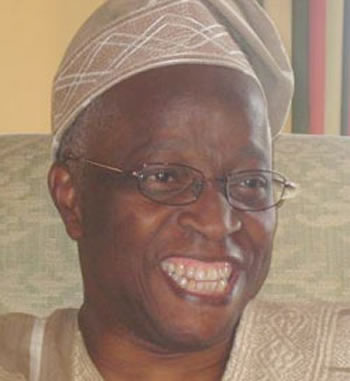
Anthony Akinola
Having read Prof. Ladipo Adamolekun’s illuminating autobiography, I Remember,
I felt justified by my enthusiasm in accepting from the publishers, the
privilege and challenge of bringing it to the attention of prospective
readers via a review. There are not many individuals who approach life
as if they have had a premonition that they could be important at some
point in history.
The culture of documenting events,
whether in a diary or a notebook, requires exceptional discipline and
commitment. Adamolekun reveals that he has kept a diary since he was 19,
and the foresight is a trait he might have inherited from his parents —
both father and mother are said to have kept records in their own ways.
This has resulted in a most authentically-documented personal history.
Adamolekun hardly requires an elaborate
introduction. He is one of Nigeria’s most outstanding academics, an
excellent scholar who once rejected a prominent political appointment in
order not to truncate his drive towards the very top of his academic
calling. A beneficiary of many scholarships, he has won several awards,
including the Nigeria National Order of Merit, the country’s “highest
national prize for academic and intellectual attainment.”
His academic discipline, public
administration, has more or less become synonymous with his name. His
numerous academic publications, according to WorldCat Identities, enjoy
close to 3,000 library holdings worldwide. There can hardly be any doubt
that Adamolekun is truly an accomplished scholar.
Autobiographers share their experiences
of both failures and triumphs. So, what factors or experiences have
shaped the life of this autobiographer, and endeared him so much to a
community of knowledgeable and decent people? The first influence in his
life, as is the case with most individuals, is parental. He is lucky
to have had parents who, even when they themselves did not have the
privilege of formal education, encouraged education in the family. Young
Ladipo Adamolekun, 14th in a family of 19 children, had the “good luck”
of having to be guided or coached by older siblings, including the
legendary Nathaniel Adamolekun, who was the first indigenous registrar
of the University of Ibadan.
The Adamolekun family, though a
polygamous one (Baba had three wives), enjoyed peace and harmony among
its members. The autobiographer attributed what I once described as
“management of polygamy” to “fairness” on the part of a father who never
spared the rod. Of course, a background of strong Christian culture
also contributed to the healthy co-existence in the family. Even when
the patriarch of the family had sponsored the education of his children
through hard-earned agricultural proceeds, children provided a helping
hand to one another once they were in paid employment. So, the first
important lesson in this autobiography is that of guidance and good home
management by parents.
The role of parents can only be
foundational. It would require a combination of talent and hard work for
any individual to achieve as much as Ladipo Adamolekun has achieved in
his academic career and other endeavours. He made a First in French at
UI in 1968. But it is in the field of Public Administration — his
research interest at the University of Oxford — that the world of
scholars now celebrates him.
Reading through his autobiography, it
would appear that his engagements at Oyemekun Grammar School (Akure,
Ondo State) where he first met his best friend, Prof. Kole Omotoso, had
prepared him for that discipline. He was the Librarian and Senior
Prefect as well as Head Boy at Oyemekun. At the Christ School,
Ado-Ekiti, where Adamolekun obtained his higher school certificate, he
was also entrusted with leadership roles: he was a prefect and head of
the school’s Literary and Debating Society. Dr. Abiodun Adu, now a
consultant gynaecologist in the United Kingdom and his junior at Christ
School, talks about him, albeit with nostalgic admiration, “Oga was one
smallish genius often seen with nothing but heavy books in his hands.”
Adamolekun’s library, in his hometown, Ladipo Adamolekun Public Affairs
Library, has about 4,500 books.
The delicate frame and gentle
disposition of Adamolekun must not be taken for granted. Just as it is
with many smart minds, Wole Soyinka and Gani Fawehinmi, for instance,
there is a stubborn or rebellious edge to his character. He is very
strong-headed in matters of principle and conviction. Even at secondary
school, he did not hesitate to tear up his examination sheet before a
teacher who had awarded him marks in English, which made a mockery of
the high marks he had attained in a mock examination in which he came
first in the class. As a political activist of the Awoist persuasion,
he once risked his life by shouting at a convoy of ruinous NNDP
politicians sometime in 1965.
But it has not been all joy and
celebration for Adamolekun. The darkest moment in his life was when his
beautiful and intelligent wife of more than 30 years, Dr. Olukemi
Adamolekun (nee Ajayi), was murdered by armed robbers in Ibadan on May
4, 2002. The narration of his years of nightmare is moving. A genuinely
loving and devoted husband and father, it took many years of pleading
and persuasion by family members and friends for him to remarry
eventually in 2007. His new wife, Olajumoke, is equally beautiful and
intelligent. Both are warmly acknowledged in I Remember.
There is a saying that the proof of the
pudding is in the eating. Adamolekun’s autobiography has some messages
for all of us. His upbringing has a message for parents generally; his
exploits as a student have a strong message for students. Of course,
his experiences as an accomplished academic at various universities,
particularly at the Obafemi Awolowo University, Ile-Ife, and as a
leading professional at the World Bank, should provide useful guidance
to those who seek to operate at the highest level of professional
calling. His description of academic standards at UI in the 1960s
should forever shame those who have been responsible for the current
decadence of educational standards in the country.
Adamolekun, even in retirement, has
continued to project the highest ideals of a true academic determined,
as he obviously is, to leave the society better than he met it. His
publisher, Chief Joop Berkhout, enthused over Adamolekun as the
quintessential professor and not the “Tokunbo” (half-baked) type. I
agree.
I Remember is an impressive and
well-indexed 352-page publication of Safari Books Ltd. Ibadan.
Adamolekun’s account of his life is a balanced narration, unlike the
hagiographic sketches that are sometimes labelled as biographies or
autobiographies. As expected, the style of presentation is fluent.
Significantly, in my view, he did not insult or malign the character of
another in a quest for self-promotion. The only missing links are his
philanthropic gestures, known to this reviewer, which he might have
chosen not to trumpet out of sheer modesty. A book that serves as a
role model for generations, it is with great enthusiasm and a sense of
professional honesty that I recommend I Remember to individuals and libraries worldwide.
- The reviewer, Akinola, wrote in this from Oxford, United Kingdom.
Source PUNCH

0 comments:
Post a Comment